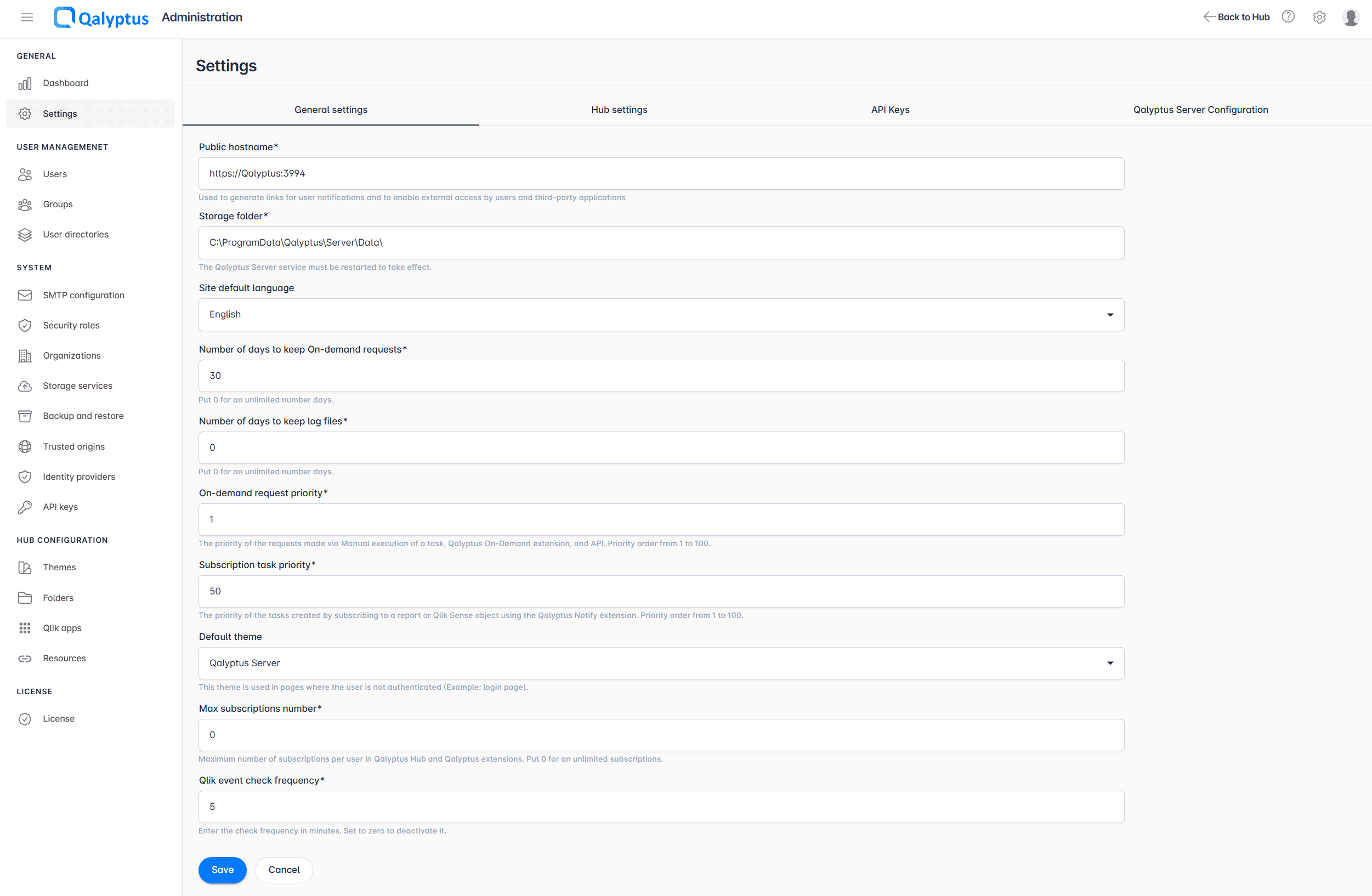
General settings
Hostname, storage, retention and task priorities
The General Settings page allows administrators to configure core Qalyptus Server parameters that affect the overall behavior and performance of the system. These settings control everything from basic server configuration to user experience preferences and system maintenance policies.
Accessing General settings
To access the General Settings page:
- Log in to Qalyptus Server as an administrator
- Navigate to Administration > Settings > General Settings
- Modify the desired settings and save your changes
Important
Some settings require a server restart to take effect. Always plan configuration changes during maintenance windows when possible.
Server configuration
Public hostname
The fully qualified domain name used to generate links for user notifications and enable external access by users and third-party applications.
Example: https://qalyptus.yourcompany.com
Storage folder
Specifies the directory path where Qalyptus Server stores all its data files, including projects, templates, logs, backups, and temporary files.
Default location: C:\ProgramData\Qalyptus\Server\Data
Service Restart Required
Changes to the storage folder require restarting the Qalyptus Server service to take effect. Ensure the new location is accessible and has appropriate permissions.
Site default language
The primary language used by Qalyptus Server for system messages, log files, email notifications, and messages displayed to unauthenticated users.
Available languages: English, French
This setting is independent of individual user language preferences configured in user profiles.
Data retention policies
Number of days to keep on-demand requests
Controls how long the system retains execution history for manually triggered tasks, API calls, and on-demand extension requests.
Options:
- 0: Unlimited retention (not recommended for production)
- 30: Keep for 30 days (recommended for most environments)
- 90: Keep for 90 days (recommended for compliance requirements)
Number of days to keep log files
Determines the retention period for system log files before automatic cleanup.
Options:
- 0: Unlimited retention (not recommended)
- 30: Keep for 30 days (recommended for most environments)
- 90: Keep for 90 days (recommended for troubleshooting)
Cleanup Schedule
Qalyptus automatically cleans up old files daily at 6:00 AM (server local time).
Task priority management
On-demand request priority
Sets the execution priority for tasks triggered through manual execution, the Qalyptus On-Demand extension, or API calls.
Priority Range: 1-100 (1 = highest priority, 100 = lowest priority) Recommended Value: 50 (medium priority)
Subscription task priority
Defines the execution priority for automated tasks created through report subscriptions in Qalyptus Hub or Qlik Sense object subscriptions using the Qalyptus Notify extension.
Priority Range: 1-100 (1 = highest priority, 100 = lowest priority) Recommended Value: 75 (lower priority than on-demand requests)
Priority Planning
Set on-demand requests to higher priority (lower number) than subscription tasks to ensure interactive requests are processed first.
User experience settings
Default theme
Specifies the visual theme displayed to unauthenticated users and as the default for new user accounts.
Use themes created in Administration > Hub Configuration > Themes.
Custom Themes
You can create personalized themes with custom colors, logos, and branding to match your organization's identity. Custom themes must be created before they appear in this dropdown.
Maximum subscriptions per user
Limits the number of subscriptions each user can create across Qalyptus Hub, Qalyptus Notify, and Qalyptus Self-Reporting.
Options:
- 0: Unlimited subscriptions (default)
- Any positive number: Maximum allowed subscriptions per user
Resource Management
Consider setting a reasonable limit to prevent system resource exhaustion from excessive subscriptions.
Integration settings
Qlik event check frequency
Defines how often (in minutes) Qalyptus checks for Qlik Sense events that trigger automated tasks.
Options:
- 0: Disable event checking
- 1-60: Check frequency in minutes (1 = every minute, 60 = every hour)
- Recommended: 5 minutes for most environments
Performance Impact
More frequent checking provides faster response times but increases system load. Balance responsiveness with performance requirements.